Domain model
01The concepts, terminology, workflows and risks shared by agents in a business area.
Campaign briefs, audience definitions and release checks.
The Center of Agentic platform
From the first business outcome to the next governed release. One platform to create useful agents, check their authority and manage the work they do.
01 / Build
Describe an outcome, start with a domain pack, and connect the approved knowledge and systems the work needs. Agent Builder guides you through six steps, from definition to release.
The concepts, terminology, workflows and risks shared by agents in a business area.
Campaign briefs, audience definitions and release checks.
Company policies, approved claims, systems and data models that describe how your organization works.
Brand guidelines, product catalogs and Marketing Cloud schemas.
The active role, workspace, approved data access and purpose of the current task.
A coordinator prepares a campaign within their granted scope.
02 / Test
Check the boundaries before release. Policy simulations use the same engine as governed runs, without calling a model. Required tests and domain-pack baselines can block publishing.
Authority tests ask whether an action is permitted. Output-quality tests ask a separate question: whether an allowed answer is useful.
Explore the release controls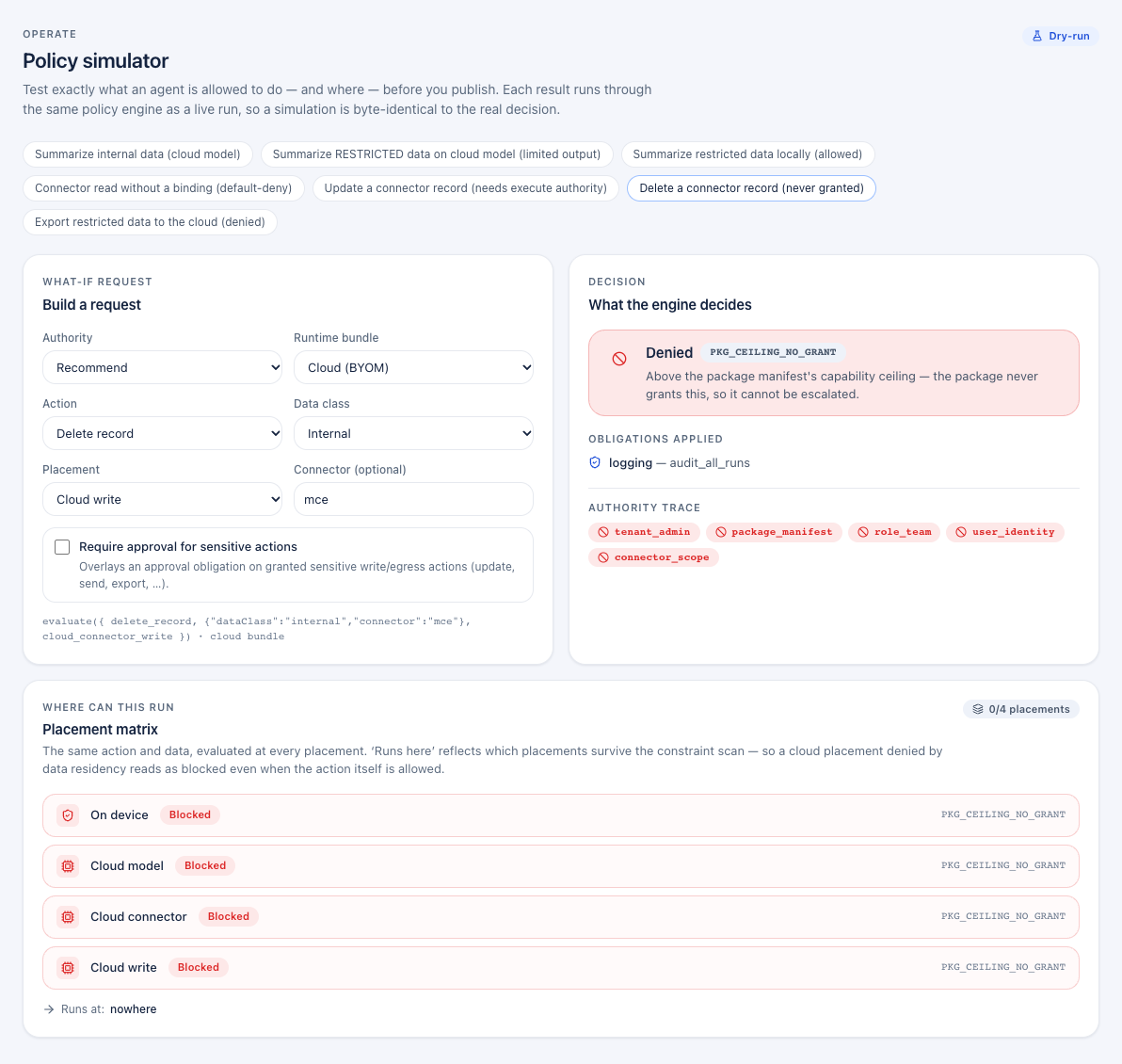
03 / Operate
Run agents in Studio. Review held operations. Inspect run receipts and changes in authority across the fleet. Turn reviewed feedback into future tests.
Understand the run evidenceStudio, Monitoring and Review Queue bring the work and its exceptions together.
Separate the policy verdict from the execution outcome. See available usage and accounting gaps.
Reviewed corrections become tests. Agents do not silently change their own permissions.
Where it works
Use the right surface for the work. Available capabilities, alpha experiences and planned surfaces are identified here.
Build, test, run and review agents in the browser, with tenant-scoped access and approval workflows.
Project-scoped local files and cloud-proxied model calls. Restricted or local-only context is withheld from cloud inference; this is not offline AI.
Tenant-scoped API access and governance-event webhooks. General external-agent governance adapters remain planned.
Configured governance alerts can reach Slack or email. Conversational agent execution in these channels is not offered here.
A collaboration surface is proposed. It is not currently an available agent runtime or approval channel.
Complete model-spend accounting remains in progress. The 420 use case explorer entries are proposals, not deployed agents or verified integrations.